



 Find additional Shakespeareances
On Beckett
On Bill Irwin On Beckett
Conceived and performed by Bill Irwin
Irish Repertory Theatre Production in association with Octopus Theatricals
Shakespeare Theatre Company's Klein Theatre, Washington, D.C.
Thursday and Friday, February 12 & 13, 2026, D–111 & M–2 (front center stalls and middle right circle)
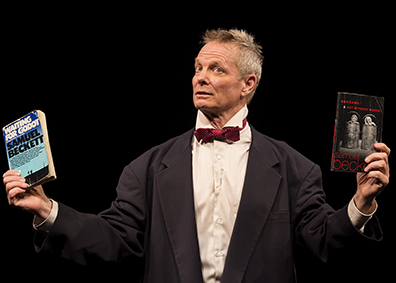
Bill Irwin discusses his sometimes fraught relationship with the playwright Samuel Beckett in his one-actor show On Beckett currently playing at the Shakespeare Company's Klein Theatre in Washington, D.C. Below, Irwin plays Lucky in an excerpt from Beckett's "most famous play," which is presumably Waiting for Godot. Photos by Craig Schwartz.
Bill Irwin is doing his one-actor show On Beckett at the Shakespeare Theatre Company's Klein Theatre, comprising a bit more than 80 minutes of Irwin talking about Samuel Becket, the Irish playwright who wrote his prose and plays in French, but this play is maybe more about Irwin, the veteran Tony Award-winning actor who describes a real love-hate relationship with Becket in On Beckett in which Irwin’s fascination with Becket's language and characters keep him returning to the man he describes as "a very tough writer with a very sensitive heart," so when he wonders "Why does this language stay in my brain?" I'm thinking it's an abusive relationship that he is playing out for us in On Beckett through which Irwin tells the audience about reading Beckett's language and performing Beckett's "most famous play" on many stages alongside a bunch of famous colleagues he namedrops and, really, he could have titled On Beckett “On Irwin” because he talks about himself as much as he does about Beckett, but with good reason—and for which I'm grateful—because the main point of On Beckett is the actor's interactions with the playwright's language, the actor being Irwin, whose program therefore probably should have been titled On Irwin On Beckett, but don't think I'm joking around here because I found the most fascinating aspect of On Beckett to be most everything Irwin says on Irwin and on the other names he drops who acted with Irwin in Beckett's "most famous play," names like Robin Williams and Steve Martin and John Goodwin and John Glover and F. Murray Abraham and Nathan Lane and, in fact, Irwin includes such a perfect impersonation of Lane that I could imagine seeing and hearing how Lane reacted to Irwin speaking the European-preferred GOD-dot pronunciation in Waiting for Godot instead of the American-preferred go-DOUGH on the production's opening night, which, as you can imagine, was quite a courageous thing for Irwin to do, as is doing On Beckett, a one-actor play about speaking Beckett's lines and playing his characters and expecting audiences to come to the Klein Theatre to see it over the course of 38 shows through March 15 and, true, some may see it twice like I did though I'm not at all a fan of Beckett, but, then, I haven't really given Becket a fair shot because the one time I did sit through Beckett's "most famous play" at the Chicago Shakespeare Theater on Navy Pier, I slept through more than half of the first half and all of the second half except the last five minutes and didn't understand a word of anything I didn't sleep through, but this—the sleeping, not the confusion—wasn't Beckett's fault because that was in 2018 when I was doing the "Shakespeare Canon Project: 42 Plays, 42 Theaters, One Year," and I squeezed Waiting For Godot into an itinerary that included two viewings of the Aaron Posner-and-Teller-directed Macbeth and interviews with Macbeths, witches, and an artistic director, and I also saw Krapp's Last Tape with John Hurt as Krapp in 2011 in this theater where On Breckett is playing, but I don't remember Krapp or his last tape, yet even with On Beckett I didn't understand much of anything Beckett wrote that Irwin spoke both nights I saw On Beckett, and although part of the reason the first night, which was the last preview performance, was my hearing aids ran out of juice as the play was starting, sitting in the center of the fourth row, my subscription seats, didn't help, and then the next night, Opening Night, I sat in row M beyond the right aisle, but fully charged hearing aides didn't help while my even atternding opening night was a kind of random decision for me to make because not only do I not have much appreciation for Beckett, he's not Shakespeare and this website is devoted to Shakespeare, but I still see non-Shakespeare plays because they almost always have some Shakespearean element in them, and if I decided to write a review I needed to see an "official" non-preview performance, so there I was amid all the opening night hoopla including tables of food that I rushed past as I left the theater to start my 45-minute drive home, which is quite the thing for a journalist to do, pass by free food without partaking of any of it, but leaving On Beckett for the second night in a row still left me with little clue on how to write this review except to point out that the not-titled On Irwin is a play well worth seeing because, first, while I couldn't understand what Beckett had written that Irwin was speaking, I did appreciate how Irwin translated all that fuzzy noise into a clear understanding of how he as an actor turns the specific nuances of what Beckett has written into impressionable character moments on the stage, which includes whichever character Beckett is portraying in the aptly named Texts For Nothing and the also aptly named The Unnamable, both of which Beckett wrote in French in the early 1950s—why in French Irwin explains, which at least is interesting if not outright weird, but Beckett did win the Nobel Peace Prize for Literature, something I've never done, so who am I to say it's stupid, but back to writing on Irwin in On Beckett—and especially the characters who are waiting, or not, for Godot, who are Vladimir, Estragon, Pozzo, Lucky, a boy, and Lane, all of which Irwin somehow presents as singular individuals though all except the last was created by Beckett, testifying to Irwin's acting skills and why he's played this play alongside so many household-name thespians, but I have to admit and reveal here that the character Irwin came up with to recite Beckett's "Text #1" of Texts For Nothing to open On Beckett was kind of creepy because he reminded me of some of the men who live in the dementia care center where my wife who has Alzheimer's lives, men who snatch at the clothes they're wearing and lose their train of thought and point at phantom objects and rub their hands et cetera in the area of their crotch and twine their legs like they really need to pee and probably already are peeing, and I wondered watching Irwin doing all this if Beckett and I share the secret handshake of dealing first-hand with loved ones who have Alzheimer's and that's what he was really writing about, except that Irwin was doing more than just acting because in that moment and for much of 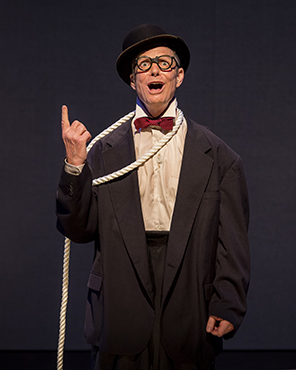 the rest of On Becket aka On Irwin, Irwin was clowning around, and I mean that seriously because Irwin is a real clown, a professional one, trained at the Ringling Brothers and Barnum & Bailey Clown College, which I hugely appreciate because I've had an affinity for real clowns since I wrote a feature story on and became friends with a rodeo clown in Oklahoma more than 40 years ago and through Shakespeareances I've met enough clown-trained Shakespearean actors, not to mention the masters of commedia delle 'arte at the D.C. theater company Faction of Fools, that I wish theater and especially Shakespeare productions featured more truly-trained clowns, and here's Irwin saying that Beckett's language is perfect for clowning and he believes Lucky's famous two-page speech, which Irwin performs in On Becket, is specifically that of a clown, and he has a right to believe that having played Lucky opposite Martin and Williams (both clowns in real life) at the Lincoln Center in 1988, and now here's Irwin in On Beckett in 2026 giving us some of the best clowning I've seen anywhere, and that alone deserves his performing On Beckett at a Shakespeare Theatre Company theater—theater with an e-r is the proper American spelling of theater, by the way, I don't care how you pronounce your Godots—but let me assure those who suffer coulrophobia, a real psychological condition I can appreciate because I suffer acrophobia which I had to overcome when I was a professional roller coaster rider (for real), that Irwin is great at adjusting you to the presence of a clown in the same manner I learned to adjust my acrophobia so I could do my job riding roller coasters and tower drops, and he does so gradually and with comforting explanation, first appearing out of darkness wearing a simple dark gray sports jacket and pants and off-white shirt and holding a bowler hat, which, it turns out, he has several bowler hats, then well into the play he announces he's about to put on baggy pants, which he does, taking off his jacket to pull the suspenders over his shoulders and ties a red bowtie around his collar and then does an incredible schtick putting his jacket back on, a gag that is nothing short of a magic trick and earns huge applause both nights (there was a lot of applause throughout On Beckett both nights, by the way), then later in his performance, as he's about to go into the extended portion of Beckett's most famous play, Irwin puts on "industrial-level baggy pants," but, most important for those of you with coulrophobia, a red nose gets only a brief sighting, and never does Irwin do the white makeup, crazy hair, monstrous red lips thing traditional clowns do, which lowers the creepy clown factor by a factor of eleven, but always there's a bowler hat, so if you have bowlerphobia you might want to stay away, except you'd miss the fascinating skit in On Beckett when Irwin does a fun show-and-tell of "the language of hats" and how hats of all sorts have their own accents and dialects and how Beckett specifically calls for the characters in his play to wear bowler hats as they are distinctly Irish yet the many forms of bowler hats also have their own individual dialects as similar as they may appear, which is a lot to say about hats but it's a cool way to get into the artistic exactitude of theatrical performances, as are the incredible physical clown routines Irwin presents, my favorite being the rising and lowering platform behind the podium, and another moment when he uses his hands to raise his head above his shoulders some six inches or more, like, how does he do that as well as turning the anatomically physical properties of his person into the essence of Gumby?
That's something to see, which is my last word on On Beckett: it's something to see.
Eric Minton
February 16, 2026
Comment: e-mail editorial@shakespeareances.com
Start a discussion in the Bardroom
