


Et tu, Booth?
John Wilkes Booth Saw Himself as Brutus;
What Does That Say About Brutus?
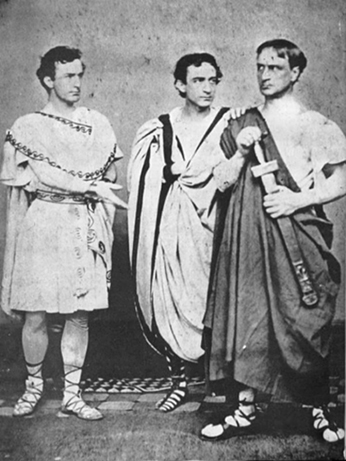
The Booth brothers combined their thespian talents for a benefit presentation of WillIam Shakespeare's Julius Caesar in 1864. From left are John Wilkes Booth playing Marc Antony, Edwin Thomas Booth playing Brutus, and Junius Brutus Booth Jr. playing Cassius. Though standing next to two Brutuses, youngest brother John Wilkes Booth considered himself American history's real-life equivalent to the Brutus in Shakespeare's play. Photo is in the public domain and can be used, copied, and modified without any restrictions. Author unknown: original is in the McClellan Collection at Brown University.
A photograph at Ford's Theatre in Washington, D.C., presents three actors in an 1864 benefit production of William Shakespeare's Julius Caesar. Two were the two most famous actors of their time, lauded for their thespian skills, their good looks, and their powerful presences. The third actor was their older brother.
Playing Brutus in the production was Edwin Thomas Booth, who, along with Ira Aldridge, are thus far America’s two most accomplished Shakespearean actors ever. To his left, playing Cassius to his brother’s Brutus, is the ironically named eldest brother, Junius Brutus Booth Jr. To Edwin’s right is his then equally famous but since then infamous younger brother, John Wilkes Booth playing Marc Antony. John was the Leonardo DiCaprio or Tom Holland of his time, a gifted actor sporting such good looks that he was one of the first theatrical celebrities to be mobbed by fans on the street. That was before he assassinated U.S. President Abraham Lincoln in Ford's Theatre.
The youngest Booth wasn’t the only one of the brothers to have life-and-death interaction with a Lincoln family member. The president’s eldest son, Robert Todd Lincoln, on holiday from Harvard and traveling to Washington, was trying to board a train in Jersey City, New Jersey, when the crowd on the platform pressed him against the car as the train began to move. Lincoln slipped down into a narrow space between the platform and moving train. He later wrote to a friend how he “was personally helpless, when my coat collar was vigorously seized and I was quickly pulled up and out to a secure footing on the platform. Upon turning to thank my rescuer, I saw it was Edwin Booth, whose face was of course well known to me, and I expressed my gratitude to him, and in doing so, called him by name.” That’s how famous Edwin Booth was. Edwin, though, had no idea whose life he had saved. He would find out several months later when young Lincoln’s commanding Union Army generals learned of the story and wrote Edwin their thanks.
Edwin's brother John shot Robert Todd’s father at Ford’s Theatre on April 14, 1865, during a production of a popular English comedy, Our American Cousin, by Tom Taylor. Robert Todd Lincoln was supposed to attend, too, but begged off due to exhaustion. This would be John Wilkes Booth’s and Abraham Lincoln’s second encounter at that theater. The president attended a production of Charles Selby’s The Marble Heart on November 9, 1863, with John Wilkes Booth playing the lead role, Raphael Duchatlet, a French sculptor whose marble statues come to life. Booth directed one of the role’s threatening speeches at Lincoln, who was sitting in his box stage left. Lincoln noted the vitriol aimed his way—"He does look pretty sharp at me, doesn’t he?” Lincoln reportedly replied to a companion sharing the box—but whether he thought it was great acting or deliberately meant for him, the accounts of that night don’t reveal.
John Wilkes Booth was a Southern sympathizer and part-time Confederate spy. He likened himself to Brutus in Shakespeare’s play, which has multiple measures of irony in that not only did he not bear the middle name of Brutus as his oldest brother did, but he despised his Lincoln-supporting brother Edwin who was a popularly established Brutus. John viewed Lincoln as a tyrant, a la Caesar, and considered himself the Brutus who would lead in the simultaneous assassinations of the president and his two immediate successors, Vice President Andrew Jackson and Secretary of State William Seward. Seward survived a vicious sword-slicing by his assigned assailant at the time Booth was shooting President Lincoln; the man who was to kill Jackson got drunk and chickened out. Booth previously had planned to kidnap Lincoln and then determined, as Brutus would likewise determine of Caesar, “It must be by his death.” Whenever he was in D.C., Booth hung out at Ford’s Theatre. When he found out the morning of April 14 that Lincoln would be attending the performance that night, he set his conspiracy in action.
If you are picking up on so many ironic and even fateful parallels between Shakespeare’s Julius Caesar and Lincoln’s assassination, then you can certainly stage Shakespeare's play in a Ford’s Theatre setting or, for that matter, at Ford’s Theatre itself as it is a working theater. But it’s Booth’s association to Brutus that is the point of this commentary, and that parallel is neither fateful nor ironic. It is ordained.
As Booth saw himself as Brutus and tried to emulate Brutus’s most significant political act—plotting and accomplishing the assassination of the nation's elected leader—he was destined to face Brutus’s consequences. Here is what Booth wrote in his journal five days before dying from a gunshot wound at Garrett's Farm in northern Virginia on April 26, 1865:
After being hunted like a dog through swamps, woods, and last night being chased by gun-boats till I was forced to return wet, cold, and starving, with every man’s hand against me, I am here in despair. And why; For doing what Brutus was honored for. What made [William] Tell a Hero. And yet I for striking down a greater tyrant than they ever knew, am looked upon as a common cutthroat. My action was purer than either of theirs. One hoped to be great himself. The other had not only his country's but his own wrongs to avenge. I hoped for no gains, I knew no private wrong. I struck for my country and that alone. A country groaned beneath this tyranny and prayed for this end, and yet now behold the cold hand they extend to me. God cannot pardon me if I have done wrong. Yet I cannot see any wrong except in serving a degenerate people. The little, the very little I left behind to clear my name, the Government will not allow to be printed. So ends all. For my country I have given up all that makes life sweet and holy, brought misery upon my family, and am sure there is no pardon in the Heaven for me since man condemns me so.
Interesting that Booth doesn’t mention Brutus’s ultimate fate which already was paralleling his own: labeled a notorious villain, even by Southern newspapers, tracked down by one of the most massive manhunts in the nation’s history, and accepting death as his fate. Also notable is that Booth faults Brutus for hoping “to be great himself.” Brutus wouldn’t dare say that; like Booth, to the end Brutus considered himself wholly honorable for his actions.
As early as my college Shakespeare classes, I've heard that Shakespeare's Julius Caesar could be titled "The Tragedy of Brutus." Would we call the events between April 14–26 "The Tragedy of John Wilkes Booth?" No. The closest such titling I'm aware of is the "Death of a Dictator" subtitle of Orson Welles's 1937 production of Julius Caesar, in which he presented Caesar as a fascist. The 2017 Public Theater Central Park production in New York presented Caesar as the newly inaugurated President Donald Trump and raised a furor among Republicans and his fan base. Many pundits pointed out that the furor missed the point of the play; whatever you may think of the duly chosen leader, assassination is never the answer. In Julius Caesar, the assassination leads to terror in the streets, the execution of the senators, a succession of civil wars, and the establishment of the very dictatorship—if not a more powerfully omnipresent dictatorship—that Brutus and his conspirators intended to prevent.
Whether Caesar as presented in Shakespeare's play is a tyrant is debatable. Caesar certainly has a huge ego when we see him in person, and he is more than willing to be crowned emperor. Meanwhile, the moments of his great humility are presented through the representations of other characters. Casca, who doesn't like Caesar and becomes one of the conspirators, describes Caesar’s thrice turning down the crown in a great public display with an obvious dose of cynicism. Antony, a close ally of Caesar who would soon reveal his own power-grabbing intentions, reads Caesar's charitable will as part of his funeral oration, and though a later comment by Antony suggests the validity of what he read at the funeral, his clear intention was to turn his audience into an angry mob. The evidence leaves the true threat of Caesar's "ambition" to the director's, actor's, viewer's, or reader's interpretation.
One thing both Brutus and Booth have in common is lacking a mirror that Cassius would have given Brutus. "Tell me, good Brutus, can you see your face?" Cassius asks. "No, Cassius," Brutus replies; "For the eye sees not itself but by reflection, by some other things." "'Tis just," Cassius says. "And it is very much lamented, Brutus, that you have no such mirrors as will turn your hidden worthiness into your eye that you might see your shadow." Cassius uses this allegory to launch his appeal to Brutus's long-established sense of honor in convincing him to join in the growing conspiracy to cut off, literally, Caesar's increasing power. If Brutus truly had the mirror Cassius describes, he would see not honor but excessive ego. So would Booth. It's fitting that John Wilkes Booth would liken himself to Brutus: both can't see that they are vainglorious scoundrels.
I credit the veteran Shakespearean and Broadway actor Patrick Page for changing what had been 45 years of what for me was the prevailing wisdom, that Brutus is the tragic hero of Julius Caesar. In December 2024, Page presented his one-actor show, All the Devils are Here: How Shakespeare Invented the Villain, at the Shakespeare Theatre Company's Klein Theatre, which is five blocks from Ford's Theatre. In a post-show talkback, an audience member asked Page of any other Shakespeare villains he would like to have added to the nine characters in his play, if time had permitted. Page mentioned only one: Brutus. I certainly didn't see that coming.
Page's key evidence of Brutus’s place among Shakespeare’s villains comes from his soliloquy ahead of the conspirators' meeting in Act II, Scene 1. As Brutus ponders how to keep Caesar from being crowned emperor he says, "It must be by his death." Page notes that in similar Shakespeare soliloquies from Richard III through Iago—and even Hamlet plotting the mousetrap—the characters debate their way to a conclusion. Brutus starts his soliloquy with his conclusion: "It must be by his death" is his speech's first line. He chooses to kill before he reasons the need. And his reasoning is building an imaginary ladder of ambition that he imagines Caesar climbing. "Therefore,” Brutus says as if his imagination is evidence aplenty, “think him as a serpent's egg which hatched would as his kind grow mischievous, and kill him in the shell." Brutus may as well have reasoned that Caesar should have been aborted ere he were born because "his kind" would become “too ambitious.”
The word honor and its derivative honorable appear 41 times in Julius Caesar. Brutus speaks the word 10 times; that's the same number of times Antony's funeral speech cynically cites Brutus as one of the "honorable" men who killed Caesar. You could actually count 11 instances of honorable in the funeral speech as Fourth Citizen echoes Antony's use of the term with obvious disdain. Honor is otherwise applied to Brutus by other characters six times in the play.
Is Brutus, then, a man of honor as reputed? He certainly thinks he is. “Set honor in one eye and death i' the other, and I will look on both indifferently, for let the gods so speed me as I love the name of honor more than I fear death.” More evidence of Brutus’s honorable bent is how often he showcases it to his associates:
- His 27-line tirade against Cassius’s one-line suggestion for the conspirators to swear an oath of fealty to each other in Act II, Scene I
- His 21-line reasoning later in the scene of why Caesar should be the only one killed, which comes back to haunt him
- His 35-line funeral speech to the public in III.2 beginning with "Believe me for mine honor and have respect to mine honor, that you may believe"
- His agreeing to allow Antony to also speak at Caesar’s funeral because “it shall advantage more than do us wrong,” which also comes back to haunt him
- And the great tent argument scene, IV.3, in which Brutus berates Cassius for not being as honorable as himself.
Much of this reflects the self-centered notion of honor that John Wilkes Booth demonstrates in his journal entry above. Consider, too, that the youngest Booth was a revered Shakespearean actor, so he likely spoke Brutus's lines often, if not on stage at least in private. If you speak Brutus's speeches with the tone Booth uses in his journal you might also hear how I hear the lines land: a lot of whining.
In Julius Caesar, note how Cassius plans to manipulate Brutus' self-esteemed honor to win him over to the assassination conspiracy, saying in an aside, "Well, Brutus, thou art noble; yet, I see, thy honorable metal may be wrought from that it is disposed." Cassius sees Brutus’s very public badge of honor as, ultimately, a mask of hypocrisy. That’s obvious to Antony, too: Caesar regarded Brutus his most trusted friend, and thus Antony calls the dagger stab Brutus made in Caesar's breast "the most unkindest cut of all."
Sure, we have reason to question Antony's motives, too. After all, Antony exonerates Brutus in his famous memoriam at the end of the play.
This was the noblest Roman of them all:
All the conspirators save only he
Did that they did in envy of great Caesar;
He only, in a general honest thought
And common good to all, made one of them.
His life was gentle, and the elements
So mix'd in him that Nature might stand up
And say to all the world 'This was a man!'
This is one of the three passages most often cited in Julius Caesar, all spoken by Antony. The other two are "cry havoc and let slip the dogs of war" speech and his funeral oratory, both of which reveal his raw opinion of Brutus. Taken in isolation, "the noblest Roman of them all" would seem to make Brutus the tragic hero of Julius Caesar.
But a different conclusion forms in the five-block nexus wherein Patrick Page at the Klein Theatre spoke of Brutus as a self-centered villain and John Wilkes Booth at Ford’s Theatre assassinated Lincoln in emulation of that same Brutus. If American history's most notorious real-life villain emulating Shakespeare’s Brutus isn’t evidence of Brutus’s true character in the play, it’s at least indicative of why Brutus was destined to the same fate as the youngest Booth brother.
Eric Minton
February 16, 2026
Comment: e-mail editorial@shakespeareances.com
Start a discussion in the Bardroom
© 2011–2026 Eric Minton
All Rights Reserved
Shakespeare Canon Project: 42 Plays, 42 Theaters, One Year
©2018-2019 Eric Minton, All Rights Reserved
On Stage On Screen On Air In Print Commentaries Dialogues Shakespearecure
Bard on the Boards Theater Links Web Links Shakespeare News Productions Seen Shakespeareances.com Top 40
Home Updates About Standards & Etiquette Sponsorships Terms & Conditions Contact
